
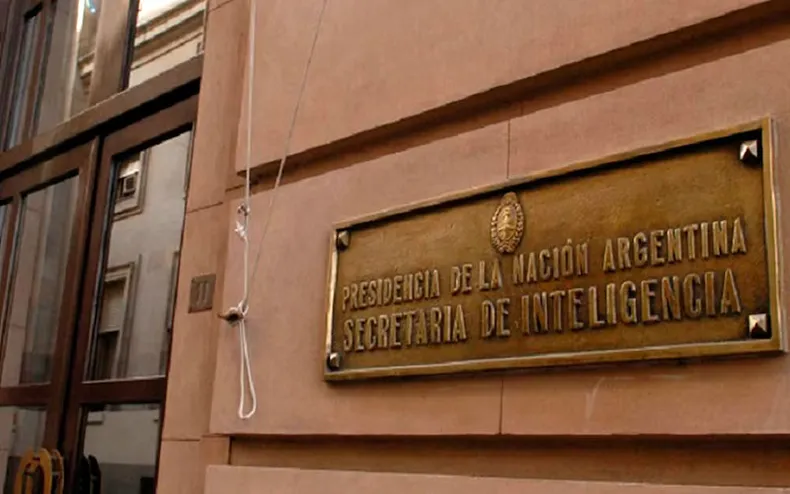
Rights groups warn SIDE arrest powers risk persecution and intimidation
 Facundo IglesiaJanuary 19, 20263 Mins read
A group of 23 Argentine human rights organizations published a joint statement condemning a January decree issued by President Javier Milei granting the intelligence agency SIDE the power to arrest people. “For the first time in democracy, intelligence agents have the power to arrest you,” said the communiqué, signed by the Center of Legal and Social Studies (in Spanish, CELS), Amnesty International Argentina, and Greenpeace, among others. The statement went on to say that the order allows agents to “apprehend” people without explaining what the criteria would be for doing so. It also stipulates that arrests can take place without judicial authorization or establishment of legal guarantees. “This paves the way for arbitrary arrests, persecution, and intimidation,” it added. The decree mandates that 15 public offices that collect citizens’ personal data share this information with the SIDE. According to the human rights groups, this will turn the decree into “a tool for massive surveillance.” They urged Congress to discuss and vote against the decree. An international presentation A group of NGOs has filed a presentation asking the United Nations to “express their concern about the restriction of fundamental rights.” They are also urging the UN to request information about the decree from the Argentine government. According to CELS litigation and legal defense head Diego Morales, the severity of the implications of the decree prompted the decision to voice their concerns publicly. The CELS has also made presentations to local courts and the Inter-American Human Rights System. “Not knowing how your personal information will be used, whether you can be arrested or not, not knowing whether participating in a protest could lead to legal consequences — we felt it was important to discuss this,” he said. Morales pointed to a change in the definition of counterintelligence. According to the decree, it will no longer be aimed at countering the potential infiltration of foreign powers but rather at allowing the SIDE to investigate and infiltrate actors who try to “influence or impact decisions made by the national government.” That change, Morales said, could allow intelligence services to investigate protests, political parties, or human rights groups. “This decree overrides a previous order banning intelligence sectors from carrying out ‘repressive’ and ‘compulsive’ tasks,” Morales told the Herald. Legally, the term “compulsive” refers to actions carried out by law enforcement meant to deprive individuals of their freedom based on suspicions of wrongdoing. This means that the new decree could allow SIDE officers to detain people not only when they are allegedly committing crimes but also for merely being under investigation. Morales referred to the case of Américo Balbuena, a former intelligence officer from the Federal Police convicted in 2023 for posing as a journalist to spy on a community media outlet. “If an intelligence agent did the same, under the new decree, theoretically, there would be no legal consequences,” said Morales. The decree incorporates the participation of the armed forces in intelligence tasks, which, according to the NGOs’ presentation at the UN, is “a dangerous historical setback.” “For decades, Argentina worked to clearly separate defense (the military) from internal security (the police). It was a lesson learned from the dictatorship: the military should not exercise control over the civilian population,” the document said. Alarming comparisons For Adam Scharpf, an associate professor at the University of Copenhagen’s Department of Political Science, the decree and treatment of political dissent under the Milei administration are raising some alarming comparisons. Scharpf told the Herald that, while Milei should not be equated “historically or morally” with the leaders of Argentina’s last military dictatorship, he is echoing some of its key rhetorical elements. As an example, he cited the libertarian’s repeated warnings about “a supposedly world-conquering socialism,” which he voiced prominently at the 2024 World Economic Forum. “That rhetoric frames political opponents not as adversaries within a democratic system, but as existential enemies of the nation,” he said. “Once political dissent is construed as a security threat, monitoring these actors, spying on them, and mapping their networks can easily come to appear not only legitimate but necessary from the government’s perspective,” Scharph added. The professor, who is also the co-author of an upcoming book on authoritarian politics called Making a Career in Dictatorship, said that, in that light, “the proposed expansion of powers for the intelligence service SIDE is not surprising.” “Comparative research shows that populist-authoritarian leaders frequently seek to personalize security institutions and repurpose them as political tools to consolidate power—a pattern observable in a range of contemporary democracies,” he said. He concluded that, if the decree is not repealed by Congress, there are severe potential pitfalls not only for the agency but for the individual agents as well. At an institutional level, he explained, the decree risks turning the SIDE into a “compliant political instrument of the executive.” At the individual level, on the other hand, it creates powerful career incentives for agents to advance professionally by engaging in practices that violate citizens’ rights and “undermine core democratic principles.”

CONMOCIÓN: murió Rosa del Valle Rasgido
 notienredSeptember 13, 20260

Claudio Barrelier reveló por qué mató a Agostina Vega: Obsesión por la
notienredSeptember 13, 20260
Asesinaron a Alfredo Wiebel y se dieron a la fuga
notienredSeptember 13, 20260


Clima en Ciudad de Buenos Aires: sábado 12 de septiembre
Sábado en la Ciudad de Buenos Aires con una temperatura máxima de...
 WindwhistlerSeptember 13, 20260
