
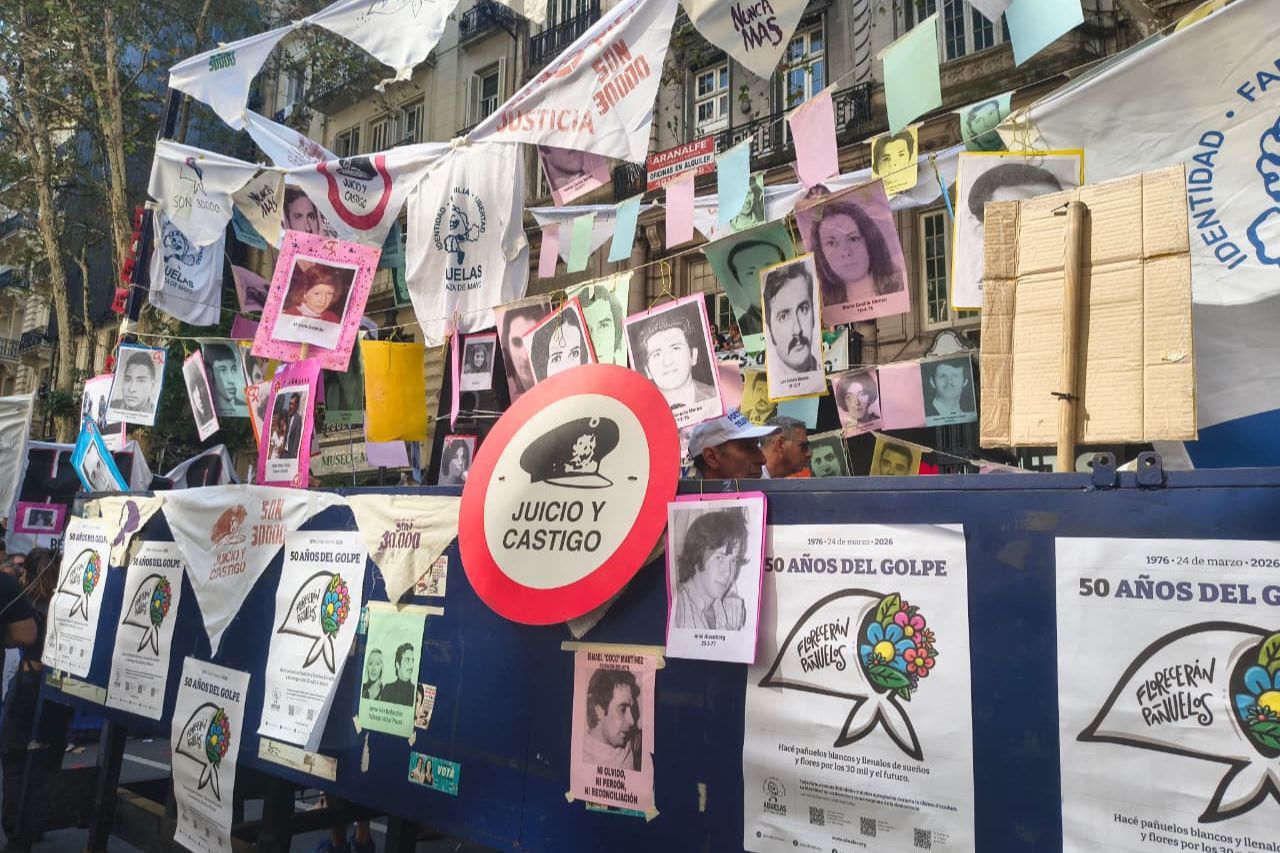
Argentines call for memory, truth and justice 50 years since the last military coup
 Martina JaureguyMarch 25, 20262 Mins read
Human rights organizations, unions, social groups and hundreds of thousands of Argentines marched to the Plaza de Mayo, in front of the presidential palace, to demand “memory, truth and justice” for the victims of the last military dictatorship, on the 50th anniversary of the coup. The commemoration took place on Tuesday afternoon, with waves of people marching on the Avenida de Mayo and nearby streets towards the Casa Rosada. With banners, artistic performances, signs and photographs, the main slogan of this year’s march was: “Tell us where they are.” The phrase is a demand for the military and security forces to release the information about the whereabouts of some 30,000 victims of the dictatorship, most of whom remain disappeared and are known as desaparecidos. It also refers to around 300 children of those dictatorship victims who were stolen and raised under new identities, and have yet to be found. To commemorate those victims, human rights organizations asked protesters to bring pictures of desaparecidos. Many also marched with photos of Mothers and Grandmothers of Plaza de Mayo who have passed away. Photo: Martina Jaureguy The landmark demonstration comes at a time when President Javier Milei has been carrying out measures that go against the memory, truth and justice policies of the past decades. On the same day of the anniversary, the government released an over one-hour-long video focused on criticizing human rights policies and the guerrilla groups that were active during the 1970s. In the video, the administration insisted on the idea of “complete memory,” which includes remembering the victims of the armed groups, but critics see this as a denialist view of the dictatorship era, which aims to lessen the horrors of the state terrorism. The main event of the march was the reading of a document which was written in unison by several human rights organizations, including Mothers and Grandmothers of Plaza de Mayo and other groups of dictatorship victims’ relatives and children, like HIJOS. Mother of Plaza de Mayo Taty Almeida, Grandmother of Plaza de Mayo Estela de Carlotto, and Nobel Peace Prize laureate Adolfo Pérez Esquivel were among the human rights leaders present on the stage. “Today, we have a government that not only is denialist; it vindicates state terrorism and genocide. This is why it dismantles policies of memory, truth and justice, and defunds memory sites that operate in former clandestine centers of detention,” the document said. Photo: Martina Jaureguy In the text, they demanded fair sentences for dictatorship criminals and criticized the benefits received by some, such as house arrest. They also questioned Milei’s economic program and policies, such as a recently approved labor reform and a modification of a law that protects glaciers, which is being addressed by Congress. “Fifty years from the genocidal coup, we are together once again on this historic square with profound conviction, to reaffirm that memory lives on. Memory is defended by fighting,” the document said. “They were 30,000 [disappeared], it was genocide. We don’t forget, we don’t forgive, and we don’t reconcile.” Read more of the Herald’s coverage of the 50th anniversary of the 1976 military coup here Sociologist Dora Barranco, who was present at the event, told the Herald that the march on Tuesday was “fundamental” because “memory always begins at the present time.” “We need to go back to that time of terror with eyes on the present time. We are going through painful times, cruel times, that will effectively end, just like state terrorism ended.” Pablo Mauro, a man who attended the march with his two teenage boys, said that they go together every anniversary of the coup as a family. “If we lose our memory, the forced disappearances and murders that happened 50 years ago can happen again,” he said. Photo: Martina Jaureguy

CONMOCIÓN: murió Rosa del Valle Rasgido
 notienredSeptember 13, 20260
Claudio Barrelier reveló por qué mató a Agostina Vega: Obsesión por la
notienredSeptember 13, 20260
Asesinaron a Alfredo Wiebel y se dieron a la fuga
notienredSeptember 13, 20260



Clima en Ciudad de Buenos Aires: sábado 12 de septiembre
Sábado en la Ciudad de Buenos Aires con una temperatura máxima de...
 WindwhistlerSeptember 13, 20260
