
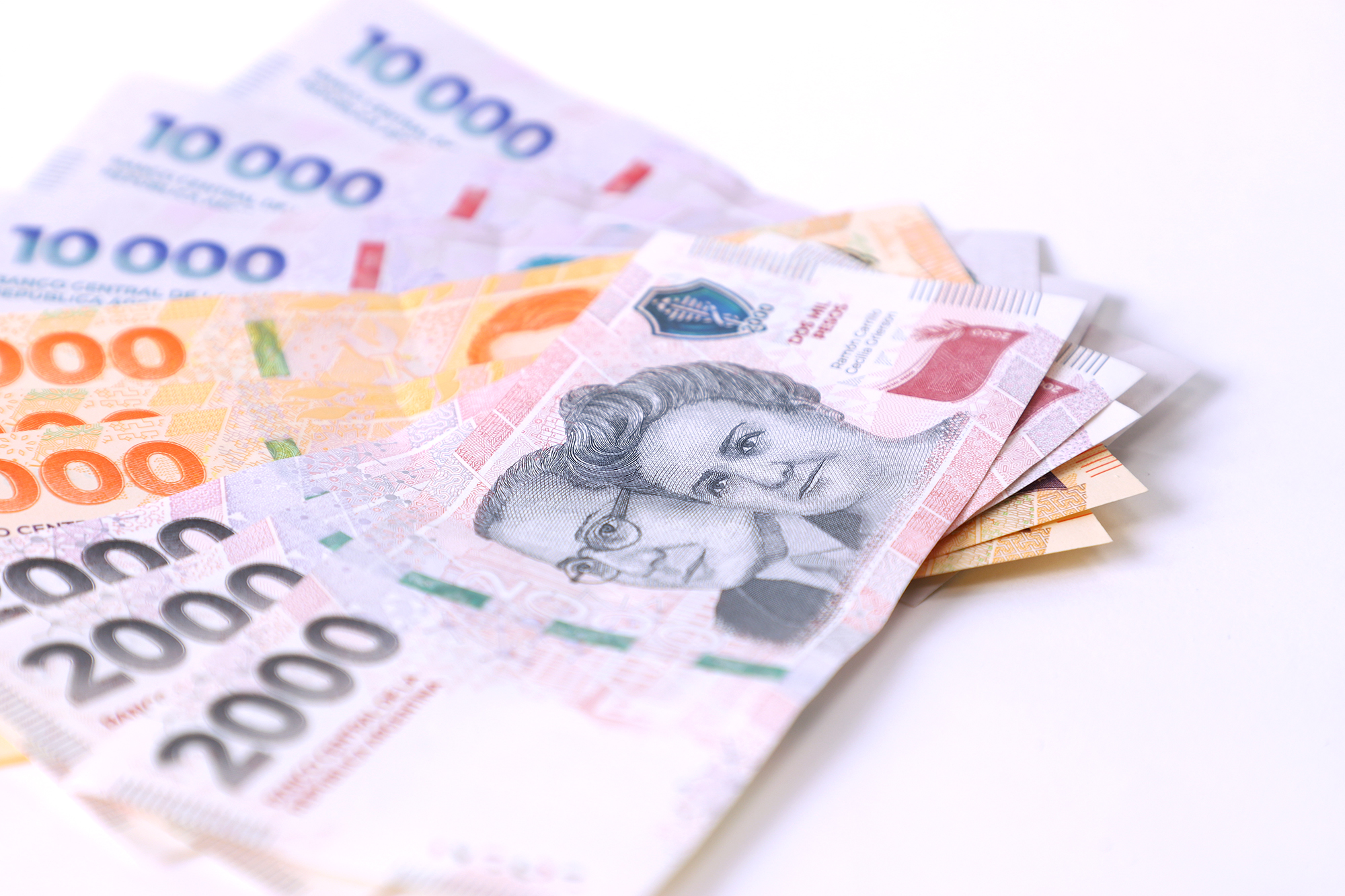
Argentine wages have fallen 20% since 2018, worst drop in the region
 Erika CabreraApril 19, 20264 Mins read
The clear deterioration of Argentine salaries is a trend that predates President Javier Milei. It is worth noting, however, that wages suffered a sharper decline over the last year of the Alberto Fernández administration (2023) and the first years of the libertarian government. According to a recent report by ECLAC (Economic Commission for Latin America and the Carribean), wages have dropped 20% over the past eight years, the worst performance in Latin America. Experts agree that the decline is directly linked to the macroeconomy. “With this macroeconomic behavior, it would have been very surprising for wages to grow or to even remain stable,” economist Luis Campos said in an interview with Herald sister publication Ámbito. Similarly, analyst Federico Pastrana said it was due to a “macroeconomic crisis and the falling of gross domestic product per capita.” In 2025, GDP grew by 4.4%, following drops of 1.3% in 2024 and 1.6% in 2023. The indicator had previously rebounded by 10.4% in 2021 and 5% in 2022, after a sharp 9.9% fall following the end of Mauricio Macri’s administration in 2019 and the pandemic. Income has been declining since 2017, with sharp drops following the currency crisis of 2018–2019 and the pandemic. This was compounded by inflation, which further eroded purchasing power. “Although several consecutive years of economic growth were achieved after the end of the convertibility regime (1991-2002), Argentina was not able to sustain that process beyond 2011,” data center Argendata noted. Public and private sector wages It is worth noting that public sector wages fell by 35.23% in real terms between 2017 and 2025, according to INDEC’s wage index and CPI. The only years during that period they didn’t fall were 2017 — slightly above inflation — and two years under Alberto Fernández (2021 and 2022). Private sector wages, meanwhile, lost 18.94% of their purchasing power between 2017 and 2025, with steep drops toward the end of Mauricio Macri’s administration (-11.69% in 2018 and -6.16% in 2019). The Milei administration has recorded a cumulative real decline of 1.55% since taking office. The end of 2025 was negative for both public and private sector workers. The former saw a 0.76% drop, while the latter fell by 2.13%. Under Milei, their purchasing power has fallen 17.03% and 1.55%, respectively. The region, on the hand, is experiencing a period of low growth, with an average expansion of around 2% annually, which limits improvements in employment and income. However, while Argentina’s average annual wage was the region’s worst performance — an 18.8% drop in purchasing power between 2018 and 2024 — Mexico and Costa Rica sit at the other end: they lead the ranking, with gains of 22.4% and 11.6%, respectively. Regional wages in other Latin American countries The 20%-plus increase in Mexico’s average annual wage is striking when considering Latin America’s history of inflationary tensions. Carlos Ramírez, partner at Integralia Consultores, a Mexican political risk consulting firm, said that “minimum wage was tied to inflation for many years” without any actual gains. That scheme changed in 2016. “Starting in 2016, Mexico began raising its minimum wage above inflation, but it wasn’t until Manuel López Obrador took office that it received a much stronger push,” Ramírez explained. Raises have been high ever since, around 20% to 25% annually, as part of a political decision to improve incomes. “They started increasing it very rapidly for political reasons,” he added. The result has been an unprecedented increase in historical terms, though with economic nuances: “They were eight years in which minimum wage grew at double digits, which has led to more than a 100% increase,” Ramírez explained. This process largely explains Mexico’s better relative performance compared to the dwindling purchasing power in Argentina. Campos and Pastrana, however, both noted that wage increases should ideally be accompanied by economic growth. Mexico grew by 1.4% in 2024 and 0.8% in 2025. There is currently a heated debate in Mexican society about whether “wage increases have had an impact on inflation, particularly in services,” Ramírez noted. He also pointed out that “employment has grown much less” and that the Mexican economy has shown weak performance in recent years. “Wages have been growing well above inflation while productivity has not increased,” which could be making the economy “more rigid,” the expert concluded. Costa Rica, for its part, saw an 11.6% improvement, making it the second-best performer in the region. According to World Bank data, GDP has been growing at around 4%. In 2022 and 2023, wage increases were close to 8%, according to businessman and financial analyst Daniel Suchar Zomer. “We’ve been outside the target range for 30 months, with nearly 26 months hovering around 0% inflation, or even slightly negative. The consumption basket has become cheaper month by month, leading to an appreciation in wages,” he explained. Suchar Zomer went on to say that Costa Rica has a “restrictive inflation rate, with interest rates higher than inflation — even higher than the regional average, which has led people from other countries to bring dollars and exchange them for local currency, putting pressure on the exchange rate.” Suchar Zomer added that deflation had not had much impact on the economy because Costa Rica has “strong ties with the global economy through free trade zones, exports, and tourism.” “While there may be some slowdown in sectors outside free zones, consumption levels remain acceptable. In fact, we are the second fastest-growing country in Central America, with growth above 4%,” he explained. Despite these regional cases, the message is clear: for sustained wage growth in Argentina — and in most countries — macroeconomic stability is essential. Without sustained growth and with high inflation, wage recovery remains elusive. Originally published in Ámbito
CONMOCIÓN: murió Rosa del Valle Rasgido
 notienredSeptember 13, 20260

Claudio Barrelier reveló por qué mató a Agostina Vega: Obsesión por la
notienredSeptember 13, 20260

Asesinaron a Alfredo Wiebel y se dieron a la fuga
notienredSeptember 13, 20260


Clima en Ciudad de Buenos Aires: sábado 12 de septiembre
Sábado en la Ciudad de Buenos Aires con una temperatura máxima de...
 WindwhistlerSeptember 13, 20260
