
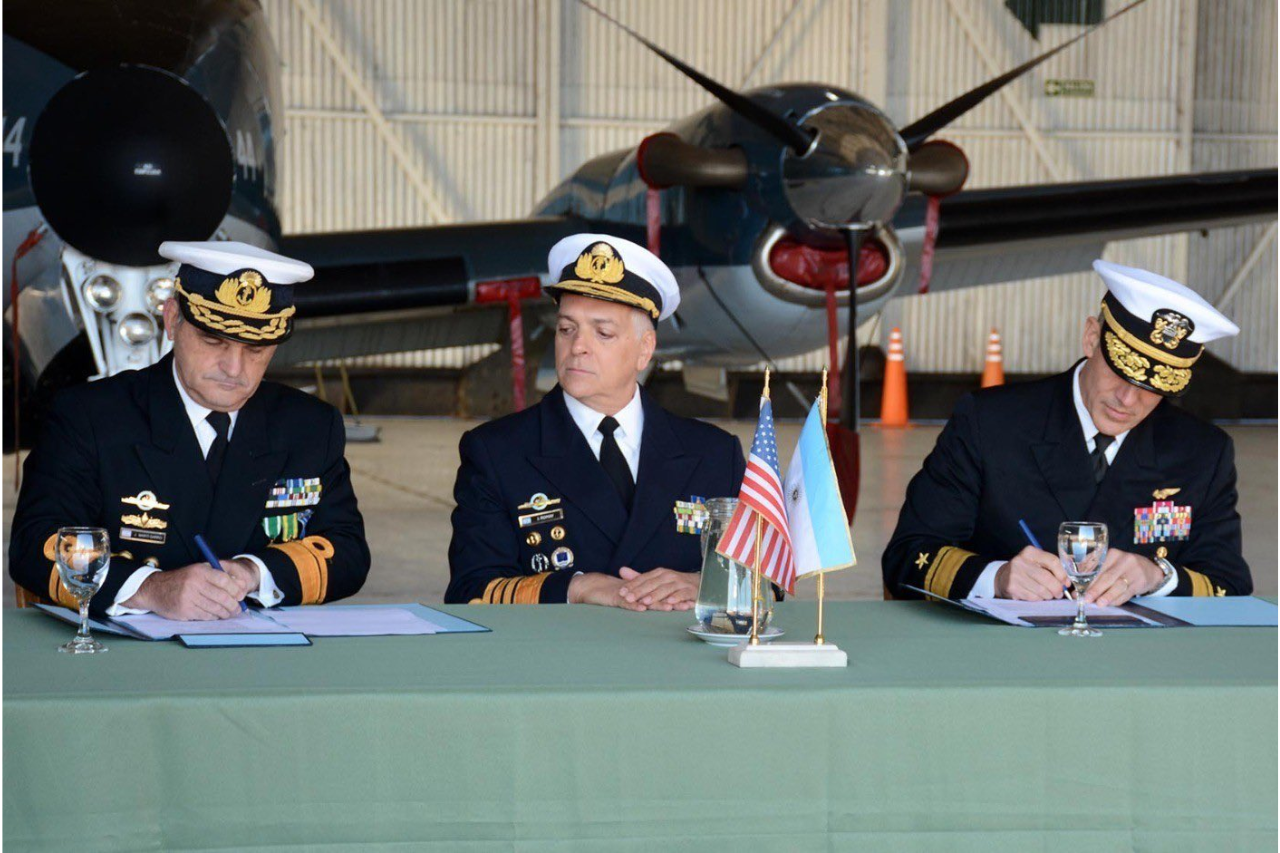
Military agreement with US labels Argentine Sea as global common good
 Martina JaureguyMay 23, 20263 Mins read
Argentina and the United States signed a new cooperation agreement that includes joint patrol operations in the Argentine Sea as part of the “Protecting Global Commons Program,” a name that sparked concerns among critics over potential sovereignty issues. Earlier this week, the Argentine Navy and the U.S. Naval Forces Southern Command signed an intention letter to launch the five-year-long cooperation program, opening the door to unprecedented foreign military presence in the area. This will allow Argentina to “fortify its vigilance and control capabilities over the South Atlantic” by incorporating new technology, operational skills, and training for the local navy, the Argentine Defense Ministry said in a statement announcing the deal. The ministry’s communiqué came two days after the U.S. Embassy in Argentina announced the launch of the deal. However, the message did not include the program’s controversial name. Only the embassy’s statement included the Argentine Sea as a “global commons.” 🇺🇸🇦🇷 Más fuertes juntos. Más seguros juntos.Estados Unidos y Argentina están lanzando el Protecting Global Commons Program para fortalecer la seguridad marítima en el Atlántico Sur.La asociación comienza con la entrega de una cámara especializada a bordo de una aeronave… pic.twitter.com/872egPPVjX— Embajada de EEUU en Argentina (@EmbajadaEEUUarg) May 18, 2026 New equipment to defend the Argentine Sea Through the agreement, the Argentine Navy will receive new equipment from the U.S., including airships and drones destined for sea patrolling, as well as a simulator for training new navy members. The program is aimed at “improving response against illicit activities and threats,” the ministry said. “We defend our maritime sovereignty with greater presence, technology, and local capabilities to protect Argentine strategic interests,” they added. The U.S. embassy in Argentina stated that the program aims to “defend global common goods and fortify regional security.” La Argentina fortalece sus capacidades de vigilancia y control en el Atlántico Sur. La @Armada_Arg y la @EmbajadaEEUUarg firmaron una Carta de Intención para desarrollar un programa de cooperación de cinco años que permitirá incorporar nuevas capacidades operativas, tecnología y… pic.twitter.com/ok4V7Q9pOP— Ministerio de Defensa (@MinDefensa_Ar) May 20, 2026 Concerns and criticism Critics, especially from the opposition Peronist party, questioned the agreement, saying it poses risks for sovereignty and the protection of Argentina’s natural resources. They also stressed that the Argentine Sea is not a “common good.” “Maritime patrol operations in Argentina’s sovereign territory are the responsibility of Argentina,” former Malvinas, Antarctica, and South Atlantic secretary Guillermo Carmona said in an interview with Radio Altos on Thursday. “Within the 200-mile maritime zone, there are 12 nautical miles over which Argentina exercises full sovereignty. Foreign vessels may transit freely through the remaining areas, but they cannot carry out sovereign control tasks — much less activities related to natural resources,” Carmona added. According to the former Malvinas secretary, “there is a strategy of internationalizing [those areas] as a step prior to direct intervention from the United States.” “The Argentine Sea is not a global commons. It is an area where Argentina has the obligation to exercise its own jurisdiction and to safeguard its resources,” said Carlos Bianco, Buenos Aires province’s minister of government. Former Kirchnerist defense minister Agustín Rossi, who served between 2013 and 2015 and 2019 and 2021, said the agreement reflects “submission,” rather than alignment, with the United States. “Handing over our sovereignty lies at the heart of Milei’s policies,” he said. “In this global context, countries that fail to build their own strategic vision run the risk of becoming subordinated to decisions made far beyond their borders,” Rossi added. “In the case of our country, this is particularly serious given our strategic position and the resources we possess,” he warned.
Conectividad regional, auge de escapadas y la pasión por el turismo deportivo del viajero argentino
El pulso del turismo emisivo en la Argentina atraviesa un momento de...
 WindwhistlerOctober 13, 20260
El último tiro cambió todo: pescó un pez elefante y ganó $ 20.000.000
Promediando el cierre de la semana pasada los pronósticos parecían tronchar la...
WindwhistlerOctober 13, 20260

Así rescataron a un cachorrito de lobo marino de un pelo en los médanos de Miramar
Un sorpresivo y emotivo procedimiento de preservación ambiental conmovió por completo a...
WindwhistlerOctober 13, 20260



Proyectan exportaciones récord del agro en 2027, pero advierten que aún faltan dólares para el año electoral
A un año de las elecciones presidenciales, la pregunta sobre si estarán...
WindwhistlerOctober 13, 20260
