
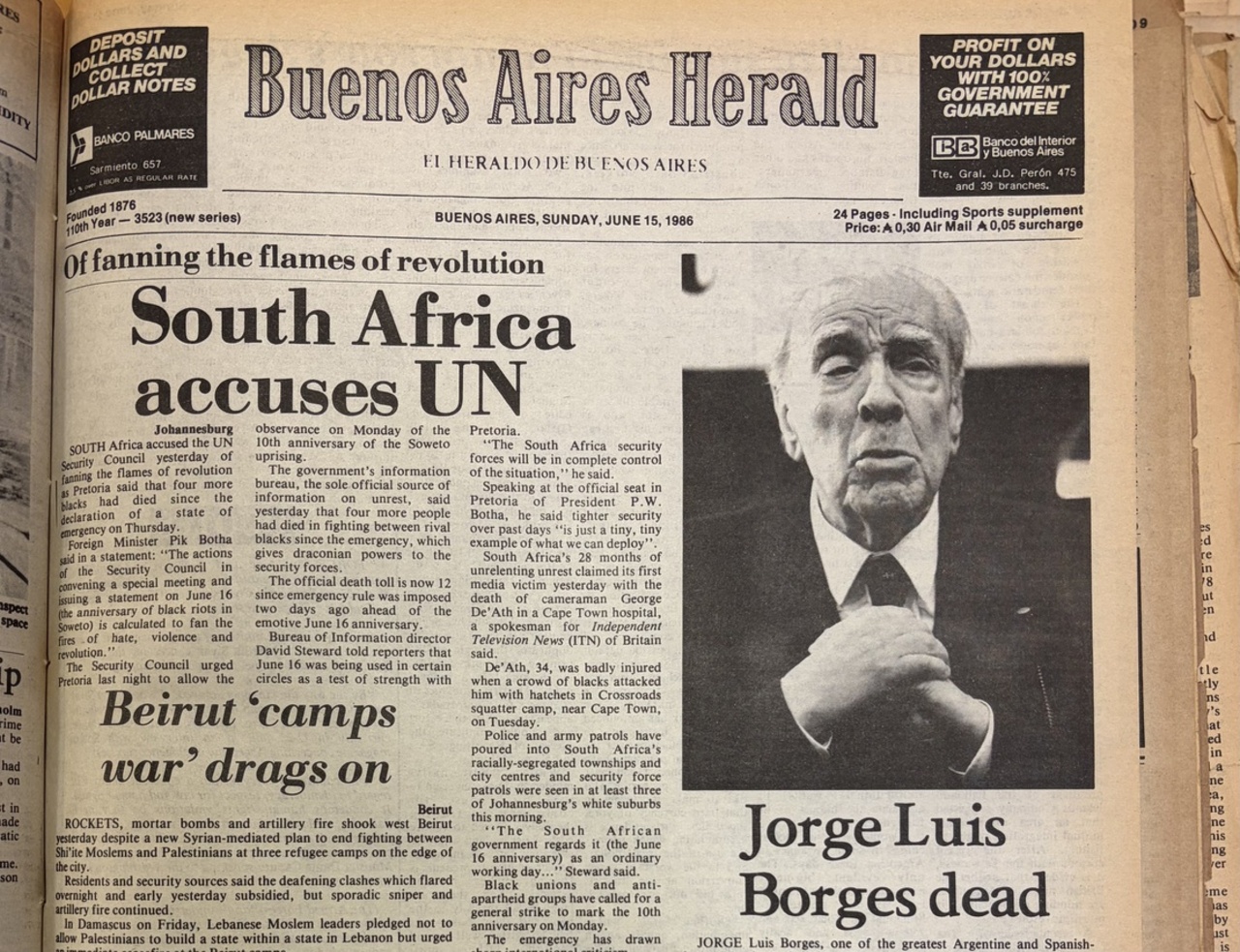
Herald Archives: Borges: May he learn to rest at ease
 Buenos Aires HeraldJune 14, 20263 Mins read
Jorge Luis Borges died 40 years ago today in Geneva, Switzerland. As Argentina’s most renowned writer, his life and work were featured throughout the Herald’s reporting on Argentine culture during the 20th century. To honor his memory, we went back to the archive in order to share the obit written by Edward Shaw, published on June 15, 1986, the day after he passed away. A U.S.-born curator and artist, Shaw was also a reporter for the Herald in the 1980s and a founding member of the Borges Cultural Center in Buenos Aires. He died in 2022. His text, an exquisite compendium of Borges in his later years, offers a tender and lucid portrayal of the man behind the genius. Read the original story below. Borges: May he learn to rest at ease by Edward Shaw Jorge Luis Borges couldn’t see with his eyes, but his other senses constructed a vision far more penetrating. Death had been a companion with whom Borges had been conversing for a long time, in an intricate game with invisible meanings. He started his trip with this most demanding of mates quite a while ago. In March he returned to the spot along the Rhine where he felt he himself had developed. Death was awaiting his return. Now he lingers in that certain but undefined limbo, having put to practice the words he repeated so many times. Aloud, he often half-joked to friends, “I have already lived too long. I want to die.” So different from that other bizarre giant of international intellect, Salvador Dalí, who has stayed off death with dreary determination. Borges, the accessible, at times bumbling gentleman who courteously accepted the greetings of well-wishers in the environs of his home by the Plaza San Martín; who lapsed into English at the slightest inducement to emphasize a point; and who said whatever he wanted about whoever he wanted. His elastic, elaborate mind meshed ideas and linked phrases. He proffered political opinions at the slightest provocation, but what he pronounced usually was more related to his literary train of thought of the moment than to the subject matter which so irritated the general public. Borges became a household icon, dusted off every time someone could pin a colorful quote to his surname. Everyone had an incident or anecdote to cite about him. He became part of the public domain. To such an extent that when he married María Kodama last month, people began to discuss him as if he were no more than a character in a Manuel Puig novel. He was so unprepossessing that the public obsessively possessed their version of him. The flesh of a man-made myth long ago has gone back to dust. The myth remains intact and will probably grow. And more important, the opus of literature he wrought word by word, combining syllables in intricate ways that man never dared before, weaving his labyrinths and mazes, mirroring the magic of the real, and capturing the ephemeral of the unreal, will survive to haunt the juries of future Nobel Prizes. Borges was a hard man to know. He was a scholar of the old school who loved the lore of the past, the legends of the primitives, the verses of classicists, and the proven quality of that which time could decant. He lived within himself. He enjoyed being with people, but dialogue never developed. He would wander like an adventurer without a chosen course, following thoughts in an ever-connecting marathon through his agile mind, casting his conclusions to whoever happened to be listening. Borges has died at 86. Though brief, the moments of matrimony he shared with María Kodama fulfilled another facet of his eternally romantic nature. Love and inspiration beat in the breast of Borges every moment of his life. Those who understood Borges knew the depth of his sentiments for María. Their union was the logical outcome of a lifelong, mutually shared relationship. No longer can the press quote with glee his out-of-context absurdities; no longer will people make irrelevant, irreverent value judgments about his conduct. Once he said, “I will be happy if a poem or two, or a line of mine lasts — anonymously.” Just as fame plagued him while alive, renown will be his fate after death. May he learn to rest at ease with his well-earned glory, which will be increasingly showered upon his literature as the trial of time proves his ultimate worth.


CONMOCIÓN: murió Rosa del Valle Rasgido
 notienredSeptember 13, 20260

Claudio Barrelier reveló por qué mató a Agostina Vega: Obsesión por la
notienredSeptember 13, 20260

Asesinaron a Alfredo Wiebel y se dieron a la fuga
notienredSeptember 13, 20260



Clima en Ciudad de Buenos Aires: sábado 12 de septiembre
Sábado en la Ciudad de Buenos Aires con una temperatura máxima de...
 WindwhistlerSeptember 13, 20260
