
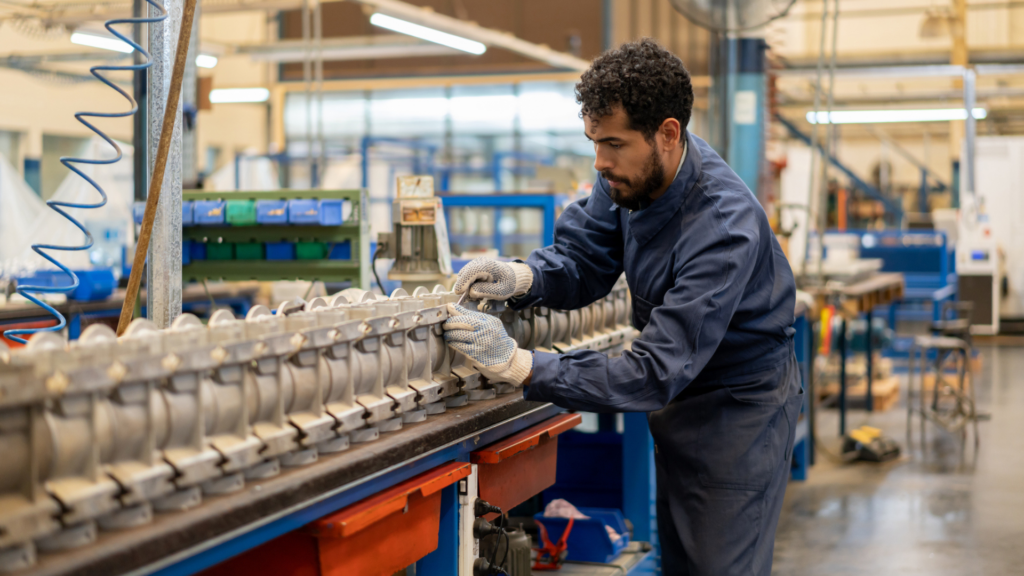
Industry rises for second month in a row, but first half of 2026 stays negative
 Juan Marcos PollioAugust 8, 20262 Mins read
Industrial activity showed significant improvement in June. According to data from statistics institute INDEC released on Friday, the sector grew by 0.9% month-over-month the second consecutive monthly increase and by 2% year-over-year. The largest monthly increase belonged to oil refining, chemicals, rubber, and plastic products (4.4%), followed by furniture and other manufacturing industries (1.8%) and food, beverages, and tobacco (1.5%). The largest declines, on the other hand, were seen in equipment, appliances, and instruments (-7.4%), motor vehicles and other transportation equipment (-3.9%), textiles, apparel, leather, and footwear (-2%), and nonmetallic minerals and basic metals (-1.9%). However, this improvement was not enough to offset the decline at the start of 2026, as manufacturing output fell by 2.2% in the first half of the year. Industry has fallen by 7% since the beginning of the Milei administration. Why is industry falling? The sustained decline since December 2023 is due to several factors. One reason is that the government implemented a trade liberalization policy unprecedented in Argentina in recent decades. This forced Argentine manufacturers to compete with products from China and Southeast Asia, which were much cheaper than their local counterparts. A prime example of this is the textile sector, which has been hit hard by foreign competition and the emergence of Chinese platforms such as Shein and Temu. Textile production in the first half of the year plummeted by 24.4%. The latest available data on capacity utilization stood at 42.2% in May. The second explanation lies in the decline in disposable income for consumption. This is linked to a drop in purchasing power since Milei took office, rising household delinquency rates, and increases in utility rates. This situation also affected the construction sector, an industry that relies heavily on industrial manufactured goods. A report released on Friday stated that sector activity had fallen 4.1% month-over-month in June, although it remained 4% above the same period last year. With the arrival of the libertarian government and the halt to public works projects implemented by Milei, construction activity is now 20% below the levels seen in November 2023, the last month before the change in government. In both cases, the trend is one of stagnation, said Santiago Casas, chief economist at EcoAnalytics, who pointed to the cooling of domestic demand as a possible reason. On the one hand, since the beginning of the year, peso-denominated credit has ceased to be a driver for these sectors, amid high interest rates for individuals and businesses. In addition to this, investment has yet to take off,” and wages are struggling to regain purchasing power, limiting the recovery in consumption. Until these three variables improve again, Casas added, manufacturing and construction will likely continue to alternate between gains and setbacks.


CONMOCIÓN: murió Rosa del Valle Rasgido
 notienredSeptember 13, 20260

Claudio Barrelier reveló por qué mató a Agostina Vega: Obsesión por la
notienredSeptember 13, 20260

Asesinaron a Alfredo Wiebel y se dieron a la fuga
notienredSeptember 13, 20260



Clima en Ciudad de Buenos Aires: sábado 12 de septiembre
Sábado en la Ciudad de Buenos Aires con una temperatura máxima de...
 WindwhistlerSeptember 13, 20260
