
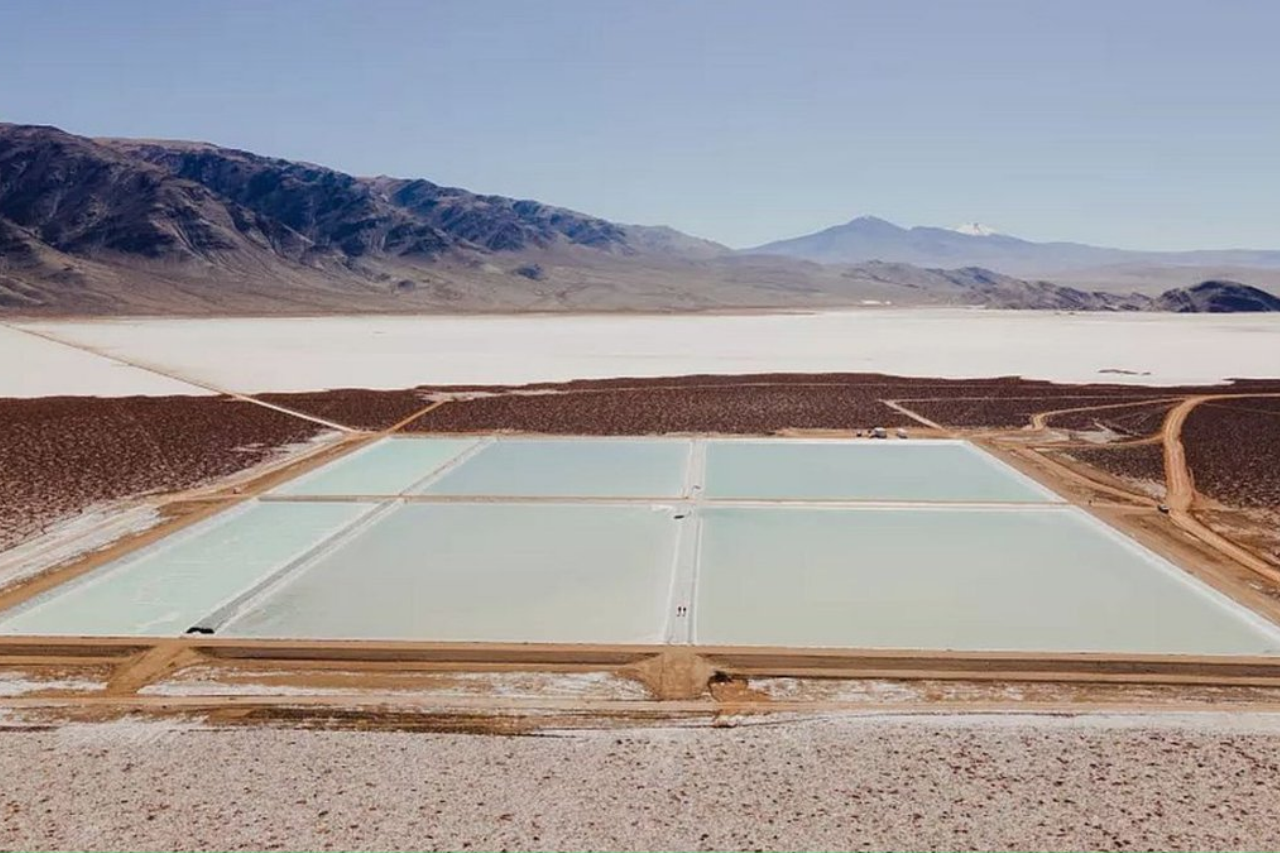
Mining is where Argentina has attracted the most foreign investor interest
 Juan Marcos PollioOctober 18, 20266 Mins read
Argentina’s mining industry is experiencing a strong resurgence, driven by a boom in exports and the growing appeal of new projects, particularly those involving lithium and copper, as well as precious metals such as gold.
Argentina recorded its highest-ever mining exports in 2025, totaling US$8.1 billion, according to data from national statistics institute INDEC. That represented a 19.2% increase from US$6.8 billion the previous year.
This year looks set to be even better. Exports from the metal mining and lithium sectors totaled US$6 billion in the first half of 2026, a 69.7% increase over the same period in 2025.
Investment is also growing. Of the 24 projects approved under the Large Investment Incentive Regime (RIGI), half are in the mining sector, with another six under review.
Against this backdrop, Argentina, Bolivia, Chile and Peru signed a joint declaration in late August aimed at attracting mining investment and strengthening regional cooperation on critical minerals.
In an interview with the Herald, Francisco Balduzzi, co-chair of Womble Bond Dickinson’s Mining Practice Group — a specialized team of lawyers who provide legal and strategic counsel to companies involved in the extraction of minerals — discussed what the agreement means for the region and how regulatory and cross-border considerations could determine which projects move forward.
He also highlighted the region’s “novel” geopolitical moment following increased United States engagement in Latin America, aimed at consolidating regional supply chains for critical materials.
Argentina, in particular, remains unattractive to some investors because of the economic and political volatility of recent decades, he acknowledged. But interest in the mining sector is growing, and it has already attracted substantial investment.
What was the most significant aspect of the agreement signed in August by Argentina, Bolivia, Chile and Peru?
More than an agreement, it is a declaration of intent to do certain things that would make mining more predictable on the one hand and more efficient on the other. It is not a declaration by the four governments saying, “Our mining policies are heading in this direction.”
Of course, it is important because it is a public statement by countries that produce copper on a large scale, such as Chile and Peru, as well as three countries that probably hold the world’s largest lithium reserves: Bolivia, Argentina and Chile.
From that perspective, its significance is considerable.
What is interesting about the declaration is that it sets out four intentions shared by these governments: first, promoting responsible mining in all four countries and strengthening supply chains between them, which already exist to some extent, particularly between Argentina and Chile, where an older agreement is already in place.
They also talk about cooperating on geology, conducting research and, more importantly, setting up technical working groups to address these issues.
It is a way of telling the world that this opportunity exists and that this is the direction they intend to take.
A joint statement by the four governments carries a certain degree of international political significance for foreign investors, because they are essentially being told that all four countries are on the same page.
Both Argentina and Bolivia are seeking investment, but Chile and Peru already have major mining industries. What do you think Chile and Peru hope to achieve with this declaration?
They also invest in those countries. In the Lithium Triangle, particularly along the Chile-Argentina border, there are many mines located right on the border. The extraction may take place on the Argentine side, while transportation or refining happens on the Chilean side, so that’s a very concrete example.
The same could happen between Peru and Chile or Bolivia and Argentina. There are natural and geographical synergies. If you have a mine straddling the Chilean-Argentine border, you do not want to apply for permits separately in Argentina and Chile, where the timelines differ. You want to do everything at once.
Although the declaration does not say any of this explicitly, I imagine that future work will involve standardizing certain procedures so that cross-border projects make practical sense for investors.
When investors consider a project that spans both sides of a border, they are thinking about a single project. Today, the countries have different laws. Argentina has the RIGI, Peru has a fairly streamlined permitting system, Chile is also known for its mixed mining companies, and Bolivia is opening up.
They are at different stages, and bringing them to a more comparable level, where things work a little more efficiently, makes investment more attractive.
Then there is the supply chain. Peru and Chile are established mining countries, where you would naturally find more service providers in the industry than in Argentina and Bolivia. This could make it easier for those providers to offer services in the other countries as well. There are many potential benefits.
I also do not think this alone will bring investment to the region. To attract investment, you then have to demonstrate that you are stable. Mining projects are long-term investments, and companies often invest in places that are not stable, but stability makes things even better.
There also has to be investor interest and signals from investors when they come to these countries to invest.
It is also important to understand that this is not just about foreign investors. It is about developing the industry locally and ensuring that an Argentine company seeking to expand into Chile, for example, understands the rules of the game.
Beyond the RIGI and this joint declaration, what would it take to trigger investment in Argentina?
That is the million-dollar question. I work in energy and natural resources, and I would say that mining is where I have seen the most foreign investors, more than in other extractive industries.
Investment has started to flow into Argentina, but it is important to understand that in the 1990s, Argentina established a regime to attract foreign investors. Over the following 20 years, however, with the exception of the period when Mauricio Macri was in government, there were expropriations and restrictions on transferring dividends abroad.
Some investors came in the 1990s, left, returned under Macri, got burned, and still want nothing to do with Argentina.
There are two groups of investors. The first consists of those who got burned and will not consider investing until another period of stability is confirmed. For them, that primarily means the president of the current administration winning reelection.
In their eyes, they are dealing with an Argentina that has repeatedly reversed course. I have met with many of them, and they want absolutely nothing to do with the country.
Then there is another group of investors who are sympathetic to the current U.S. administration. They see what the U.S. government is doing across Latin America as something novel. The United States has taken a more favorable approach toward Latin America than we have seen in many years, and investors in this group are putting money into the region.
In my view, if you compare Argentina’s oil and mining sectors, there are more foreign investors putting money into mining than into oil.
Argentina has a problem because it has behaved badly in the eyes of the world for many years. Rebuilding that trust is not just a matter of passing laws. Once you change them, you have to enforce them and remain consistent over a period of time.
Something interesting happened when the currency swap with the United States was announced. Inquiries to my office accelerated because the fact that the U.S. was backing Argentina sent a very strong signal.
Some investors come in and bring others along, including investors who may otherwise go unnoticed. That is a reality.
Lithium experienced a major boom, which subsequently slowed as prices stabilized. Copper, meanwhile, was already in short supply even before the energy transition and the expansion of renewable energy.
Demand for copper is enormous. Chile and Peru are major copper producers, and Argentina also has huge potential to produce the metal.
If Argentina achieves that stability and the United States continues with a policy similar to its current approach, it could greatly benefit the region. It is a combination of factors; it is not just about what happens in Argentina.
Investors still have to come. Argentina can do everything right, but if another jurisdiction has better geology, mining companies will go where the geology is better.
In mining, I think Argentina is where foreign investors have shown the most interest.
Do you think investors’ perception of Argentina as a country without legal certainty could change in the coming years?
Changing that perception of Argentina as a whole will take a long time. In mining, however, the process has already begun, and as more investments come in, more will follow.
If there are binational projects, having an agreement with Chile is a major advantage for investors. If these initiatives materialize, investment can be carried out more efficiently, whether in permitting, regulations or other areas.
Could Argentina become a mining country like Chile and Peru in the coming years?
Argentina has enormous potential, but those countries have a longer history in mining.
Argentina is not just about mining, though. It is very different from those countries because mining is their main commodity. Argentina, for better or worse, is rich in many different resources.
Inside Vaca Muerta: a boomtown, millionaire wages and talent shortages
From 6 p.m. onward, the cold intensifies, and the wind throws you...
 Nazarena LomagnoOctober 18, 20260
Latin Americas exports surge 20%: a new commodity boom looming?
Despite a year marked by geopolitical uncertainty stemming from the war in...
Juan Marcos PollioOctober 18, 20260

The B-side of Argentine rock: five hidden albums by its biggest stars
As with every story, music always has a B-side. Argentine rock has...
 Ayelen CisnerosOctober 18, 20260



Annemarie Heinrich: the eye behind Argentinas star portraits
When Annemarie Heinrich photographed an actress named Eva Duarte in 1938, she...
 Agustin MangoOctober 18, 20260
