
Why the suspension of the university funding law is technically dictatorial
 Pedro CaminosJune 10, 20264 Mins read
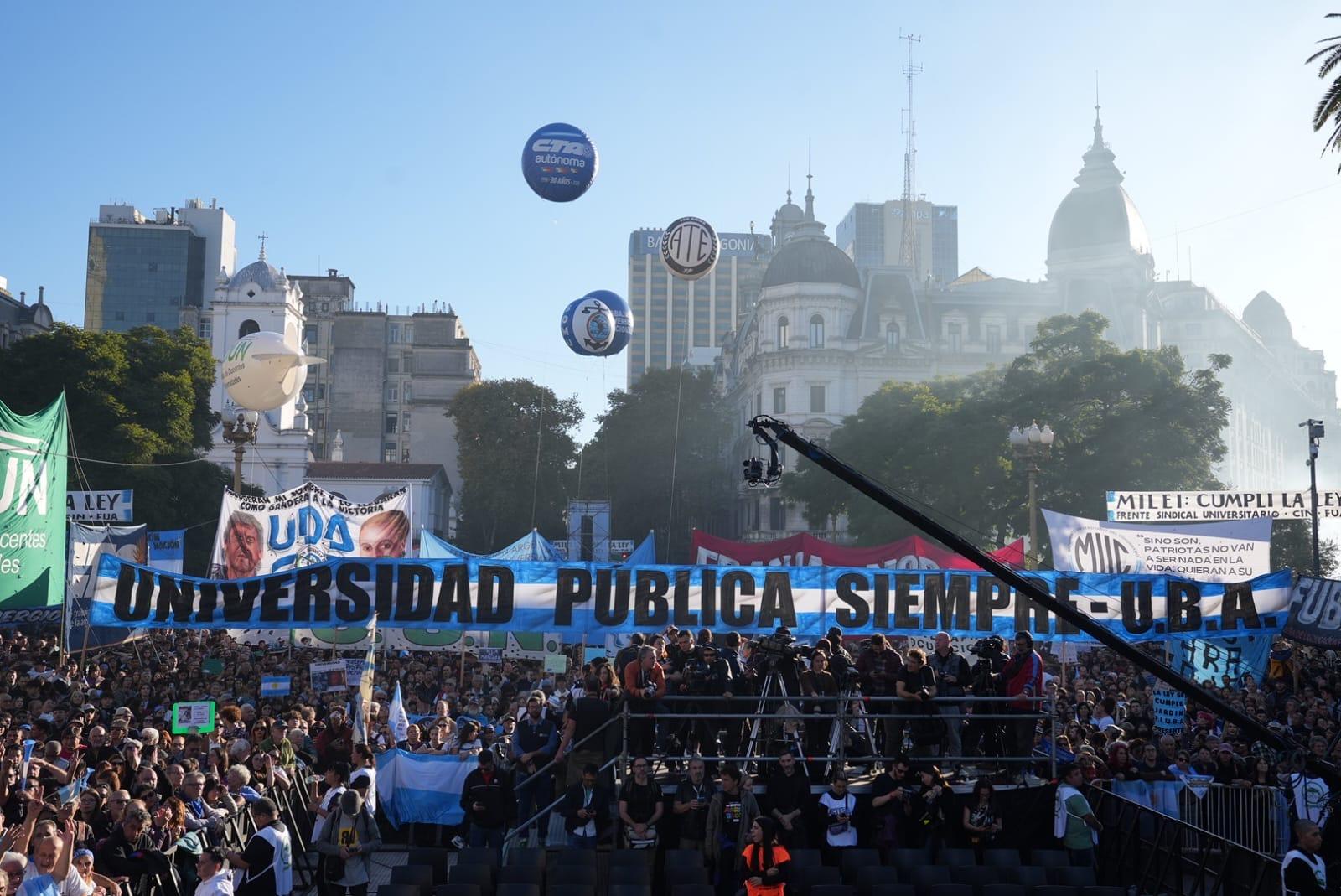
Within a democratic system, the use of the term dictatorship has both an emotional and a technical meaning. The former is generally used to describe a government’s authoritarian use of power. The latter refers to bending the law sometimes even suspending existing legislation with the aim of achieving goals that the government deems highly important. President Javier Milei has carried out several acts that can be defined as “technically dictatorial. The suspension of the university funding law is one of them. How we got here Argentina was experiencing severe inflation when Milei took office in December 2023. According to official data, annual inflation in 2023 was 211.4%, while in the following two years it was 117.8% and 31.5%, respectively. Despite this, no budget law was passed for 2024 or 2025. This meant that stipulated public spending remained at 2023 levels. This is because the Financial Administration Act, the legislation governing the use of public funds, stipulates that if a budget law is not enacted for a given year, the previous years law is automatically extended. The budget approved for 2023 remained in effect for the following two years despite cumulative inflation of 791.7% over those three years. This profoundly affected Argentinas public universities. Faculty, staff, and students protested and looked to improve their situation through lobbying and mass demonstrations in the countrys major cities. In 2025, Congress passed the university funding law. This was not a real increase in public spending for universities, but rather an adjusted-for-inflation update to their budget in order to ensure their operation. An overturned veto Although the president vetoed the bill, Congress was able to push the legislation through by securing a special majority in each of its chambers to overturn his decision. When that happens, the president is constitutionally required to sign the bill into law and begin enforcing it. Milei, however, had other plans. The president signed the law into effect, but in that same decree he also suspended its implementation. To do so, he invoked the Law on Complementary Rules for Budget Execution. It stipulates that if a law authorizes expenditures, it must expressly provide for their funding. If it fails to do so, then its implementation will be suspended until the appropriations are included in the budget law. With the laws implementation suspended, public universities decided to file a lawsuit. This led the courts to issue a provisional order requiring the government to comply with the law. The government appealed that order to the Supreme Court, which must now make a decision. Why this is ‘technically dictatorial A dictatorship is the negation of the rule of law. By choosing the appropriate means to achieve his ends, the dictator can act without regard for existing laws. In his essay on the concept of dictatorship, German philosopher Carl Schmitt outlined three elements: technicity, rationality, and execution. The dictator acts on the basis of a mandate that sets forth a specific goal to be achieved. The idea of technicity lies in the fact that the dictator will choose the most appropriate means to fulfill this mandate. In this case, the stated goal is to avoid a fiscal deficit, and the technical means chosen is the suspension of a current law. “Rationality,” meanwhile, carries a dual meaning. On one level, it refers to the idea that reason dictates the most effective means of achieving a given end. On another, it implies that those who oppose the dictator are acting irrationally. Mileis decree captures this element by arguing that Congress does not understand the rules governing the budget extension and that the university funding act would impose a requirement that is impossible to fulfill. Hence the rationality of the chosen means, which is the suspension of the law. Finally, “execution” refers to the fact that a dictators decision is not merely a rule but constitutes an action in itself. In this case, the technically dictatorial action is an omission: failing to adjust the budget allocation for universities to account for inflation. The Financial Administration Law does not give the president discretion over whether to include provisions necessary to ensure the continuity of state services. Rather, it imposes a duty to do so. At the same time, the Law on Complementary Rules for Budget Execution is not applicable in this case. This is because the university funding law did not authorize an expenditure not provided for in the budget law, nor did it authorize an increase in real terms of an expenditure already authorized. Instead, it provided for an adjustment to an already budgeted expenditure in order to preserve its real value. The government has justified their position on the grounds that the approval of a new budget law, which was approved in February 2026 and includes an allocation for universities, makes the previous funding law void This position, however, does not resolve the problem regarding previous years. Indeed, the outdated budget allocation provided for the year 2023 was maintained throughout the next two years, which was precisely what the university funding law addressed. A dangerous precedent This dictatorial exercise of power, in the technical sense, is concerning for three reasons. First, because it sets a precedent that could be invoked in the future by Milei or other presidents to refuse to comply with a law passed by Congress (a terrible signal to foreign investors, who are always concerned about legal certainty). Second, because it is a clear violation of the basic rules governing the functioning of a constitutional democracy. The mere will of the individual occupying the presidency cannot prevail over a law adopted by special majorities in Congress amid significant citizen mobilizations. Finally, because its objective is to lead to the dismantling of the public university system, a decision that goes hand in hand with the dismantling of the countrys scientific system. This will have direct consequences for the production of knowledge and also for the functioning of politics. As Vicki C. Jackson, a professor of constitutional law at Harvard University, pointed out, contemporary autocracies are characterized, among other things, by their attempts to destroy institutions of knowledge, such as universities, to prevent the existence of alternative sources of authority that might compete with them. In short, the Argentine Supreme Court has much more than a legal case on its hands. It must decide whether the president can, technically, become a dictator and, in doing so, subvert the rule of law, democracy, and the production of knowledge in Argentina in a single act.

CONMOCIÓN: murió Rosa del Valle Rasgido
 notienredSeptember 13, 20260

Claudio Barrelier reveló por qué mató a Agostina Vega: Obsesión por la
notienredSeptember 13, 20260

Asesinaron a Alfredo Wiebel y se dieron a la fuga
notienredSeptember 13, 20260



Clima en Ciudad de Buenos Aires: sábado 12 de septiembre
Sábado en la Ciudad de Buenos Aires con una temperatura máxima de...
 WindwhistlerSeptember 13, 20260
