
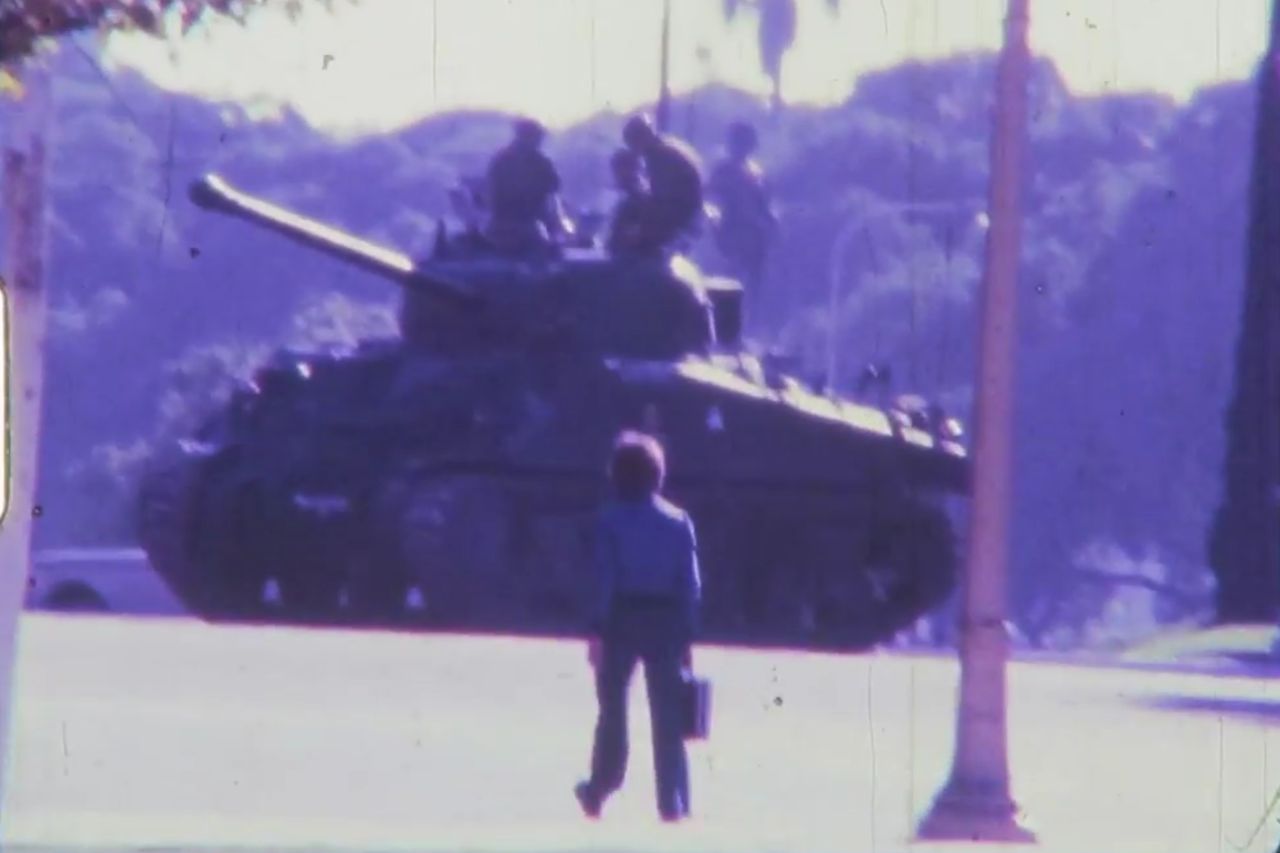
March 24, 1976: the day Argentinas darkest period began
 Martina JaureguyMarch 24, 20266 Mins read
It was the early hours of Wednesday, March 24, 1976. Outside, it was dark. Sunrise was still several hours away when the voice on the radio made the announcement: Isabel Perón’s government had fallen. The reins of the country had been, once again, taken over by the armed forces in Argentina’s sixth coup d’etat, one that would lead to the darkest period in the country’s history, with the forced disappearance and murder of 30,000 people at the hands of state terrorism. At around 3 a.m., a military march started playing on all radios. From the Casa Rosada, the presidential palace, and broadcast to the entire country, the voice of official announcer Juan Vicente Mentesana read out the proclamation of the new military junta explaining the motives for the coup. “Having exhausted all constitutional avenues, having ruled out the possibility of corrective action within the institutional framework, and having irrefutably proven the impossibility of restoring the process through normal channels, a situation that harms the nation and jeopardizes its future has come to an end. […] The Armed Forces, in fulfillment of an inalienable duty, have assumed control of the State,” the message said. The proclamation was signed by the heads of the three branches of the armed forces: Jorge Rafael Videla (Military), Emilio Eduardo Massera (Navy), and Orlando Ramón Agosti (Air Force). Soldiers had broken into TV and radio stations and taken control. Over the course of the morning, the broadcaster read out 31 new “communiqués” issued by the Junta, including a ban on gatherings and any political activity, the death penalty for anyone who hurt or murdered security force members, a takeover of unions, and the shuttering of Congress, among many others. Armed soldiers in Plaza de Mayo on March 24, 1976. Photo credit: screenshot from anonymous film footage recovered by the Buenos Aires Film Museum Beatriz (38 at the time) was travelling with her father from her home in Isidro Casanova to a Jehovah’s Witnesses’ assembly in Bahía Blanca, in Buenos Aires province, in the early hours of March 24. It was well past midnight when she started seeing soldiers bearing arms alongside the road. They were pointing their weapons at the cars. Her father was fast asleep beside her, so she woke him up. “Dad, there are soldiers outside. What do we do?” she asked him. “Just continue driving,” he replied. After struggling with the signal, they managed to turn the radio on. That’s when they found out Isabel Perón had been arrested and taken away in a helicopter. She would spend the next five years under house arrest, on accusations of corruption. Other fellow Peronist government officials were arrested under similar charges. The governments of the provinces and large cities were taken over by the military. Beatriz and her father arrived in Bahía Blanca in the morning. “There were no movements on the streets. Some people hugged each other and laughed, because we were all expecting some change,” Beatriz tells the Herald, referring to the widespread unpopularity of Isabel Perón’s government amid an economic, social, political, and institutional crisis. The Jehovah’s Witnesses’ assembly was forcibly canceled. Social gatherings were now banned. “For people like us, who are not involved in politics, those sorts of political movements scared us. They made us fear for our kids and be scared to go outside because we had endured everything that was happening with the guerrillas,” says Beatriz, now 88. She had a teenage boy and girl waiting for her to return home. A crumbling government Historian Gabriela Águila, author of History of the Last Military Dictatorship, says the military takeover “had been long awaited, and it was likely the most foretold coup in Argentine history.” Rumors about it had begun as early as 1975. Isabelita Perón — real name María Estela Martínez de Perón — became president after the passing of her husband, Juan Domingo Perón, on July 1, 1974. Isabel was his vice president, and as such, she had to take over the government despite her political inexperience. Her administration was short-lived but chaotic and institutionally weak. Inflation soared, as did living costs, social conflict, and political violence. Between the actions of left-wing guerrillas and Peronist revolutionary armed organizations that had begun in the late 60s and far-right paramilitary groups — the most prominent one was the Triple A, backed by government members — aimed at eliminating what they called the “subversion,” the years leading up to the coup were violent times for everyday life. In 1975, Isabelita authorized the military to “annihilate” the Ejército Revolucionario del Pueblo (ERP) guerrilla in the northern province of Tucumán, in what was known as Operation Independence. This emboldened the political and repressive power of the armed forces. For Águila, the operation was “a trial experience of the state terrorism” that would come in the following years. A man smoking while walking in front of a military tank in Plaza de Mayo on March 24, 1976. Photo credit: screenshot from anonymous film footage recovered by the Buenos Aires Film Museum Read more of the Herald’s coverage of the 50th anniversary of the 1976 military coup here “Passive attitude” At around 7 a.m. on March 24, 1976, 18-year-old Miriam Lewin was awakened by her mother holding a radio. A military march was playing. She told her daughter that the military had taken over the government. Miriam just hugged her legs and cried. “I saw that Argentina was still in a pendular movement between short, civilian governments and military dictatorships, something that had been happening since the 1930s. It was very distressful because we didn’t know what was going to happen.” Miriam was an economic sciences student at the public University of Buenos Aires and was also attending a private journalism school. She was part of the Peronist University Youth, a political organization that answered to Peronist guerrilla Montoneros. However, she was not involved in armed operations, focusing instead on disseminating their ideas among students. “Near the date of the coup, it was evident that the Argentine political system was not providing answers for the institutional crisis under Isabel,” Miriam told the Herald. “For us militants, a potential coup was threatening, but at the same time, we were already the target of the repression of the Triple A.” “Things were so bad that I thought that the military would maybe put some order to the repression. I thought they would maybe arrest us, take us to trial, and convict us,” Miriam recalls. “What we did not foresee is that the state would turn into a terrorist one and that they would use methods such as forced disappearance, death flights, and the appropriation of babies.” Later that day, Miriam went outside to meet some friends. The streets of Buenos Aires, the Argentine capital, were flooded with soldiers, even tanks. But the few passerbys she saw were not reacting to the situation. “People had a completely passive attitude,” she remembers. School and public administration activities were suspended, and a bank holiday was declared. Footage of that day from an anonymous Super 8mm film, however, shows people walking in Plaza de Mayo, going about their day like any other while tanks with armed soldiers patrolled the area. The newspapers from the 25th said that the 24th had been a normal day. During the first days and months of the coup, there were no clear signs of resistance from the public. Business entities, right-wing political parties, Catholic sectors, and even the international community backed the coup. The General Confederation of Labor and Peronist organizations said they would carry out a strike, but it never occurred. However, with time, resistance built up, leading to the formation of human rights organizations and other groups that criticized the regime. A year later, that same Plaza de Mayo would become the symbol of the fight against state terrorism and human rights violations when a group of mothers and relatives of the thousands of people who were disappearing at the hands of the military began meeting there and walking in circles, wearing white handkerchiefs in front of the Casa Rosada. Fifty years on, the Mothers of Plaza de Mayo still march every week to demand to know the whereabouts of the estimated 30,000 desaparecidos of the dictatorship. One of the people they fought for was Miriam Lewin, who was kidnapped in March 1977 and held at the most notorious of the clandestine detention centers of the military, the Navy School of Mechanics (ESMA, by its Spanish initials), where she was tortured and forced to do slave work. After her release, in 1979, she went on to become a renowned journalist and writer and testified as a witness in the historic 1985 trial against the military juntas. To this day, she fights for justice for those who were never seen again. Cover photo credit: screenshot from anonymous film footage recovered by the Buenos Aires Film Museum
CONMOCIÓN: murió Rosa del Valle Rasgido
 notienredSeptember 13, 20260
Claudio Barrelier reveló por qué mató a Agostina Vega: Obsesión por la
notienredSeptember 13, 20260
Asesinaron a Alfredo Wiebel y se dieron a la fuga
notienredSeptember 13, 20260


Clima en Ciudad de Buenos Aires: sábado 12 de septiembre
Sábado en la Ciudad de Buenos Aires con una temperatura máxima de...
 WindwhistlerSeptember 13, 20260
