
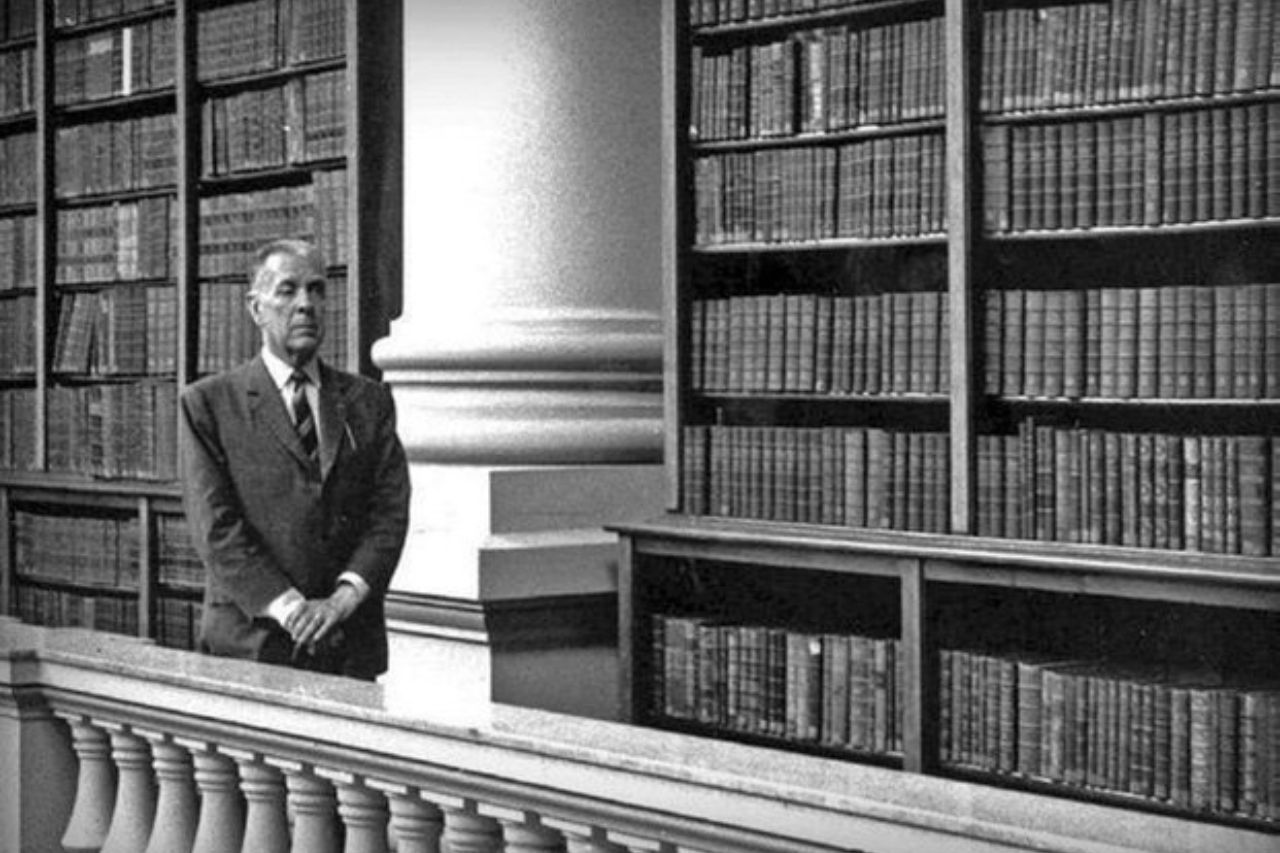
Borges, the man who turned Argentine literature into a laboratory
 Sebastian HernaizJune 14, 20264 Mins read
History likes symmetries and mild anachronisms, but it’s hard to place a final form on what emerges from the events themselves and their anniversaries. Jorge Luis Borges, born in Buenos Aires in 1899, died 40 years ago in Geneva, on June 14, 1986. We can also say that he passed away eight days before Diego Maradona scored two goals against England at the World Cup that Argentina would go on to win in Mexico — it all depends on how you arrange the dates. At the end of the 19th century, Argentina was a country with vast wealth inhabited by poor people. Borges grew up in a comfortable middle-class home with traces of an older lineage. Think of relatives who had taken part in the distant wars of independence or a piece of land that had once yielded some income. Borges’ father was the son of an Argentine military officer and an English immigrant. He had a law degree but actually worked, for as long as his body allowed, as a psychology professor. With the vast library and the English language on his father’s side, coupled with the family heritage and Spanish language on his mother’s, Borges wove together a unique form of literature. Readers of his work, such as Argentine critics Ricardo Piglia and Beatriz Sarlo, have argued that Borges, working from the most unexpected coordinates of a Buenos Aires basement, turned Argentine literature into a laboratory where he dismantled Western traditions while also transforming the country’s literary tradition into a universal one. Borges himself fictionalized this crossing using the taut idea of “the discord of his two lineages.” He would treat José Hernández, author of the epic poem Martín Fierro, as if he were reading a European novelist. Or present James Joyce as an Irishman one might bump into on a street corner in the Buenos Aires neighborhood of Balvanera. These crossings demanded he put his famous erudition and vast reading to use. Above all, however, they demanded remarkable audacity from him, something his texts never lacked. An original audacity at work In 1925, Borges translated a fragment of Joyce’s Ulysses in a Río de la Plata-style Spanish. In that text, he emphasized the known “boldness” characteristic of the Irish for stirring up English literature, always “less sensitive to verbal decorum than their detested lords.” Borges weaves together the history of the English colonies and the innovations of Irish literature into an idea of how audacity allows the dismantling of ossified traditions and hierarchies. And he himself will, in fact, posit these very ideas with audacity. In that very introduction to Ulysses, he admits to having read no more than “bits and pieces” of “all seven hundred pages.” Nonetheless, he asserts that he believes he knows the book well, just as any citizen feels able to claim “knowledge of a city, without ever having been rewarded with the intimacy of all the many streets it includes.” Although he is now more a familiar name than an author who is actually read, Borges wrote books that are foundational to Argentine and world literature. Among them, Fictions, The Aleph, Fervor of Buenos Aires, Other Inquisitions, and The Size of my Hope are some titles, gathering stories, poems, and essays, among many that would justify any exaggeration about his importance. He posited radical hypotheses about literature, turning the most established cultural premises on their heads and etching out ideas that became pillars upon which he built his work. Among them, that originality is merely a way of naming combinatorics, and that “the notion of a definitive text belongs only to religion or exhaustion”; that reading is an activity “subsequent to writing: more resigned, more civil, more intellectual”; and that an absolute memory had nothing to do with intelligence, since “to think is to forget a difference, to generalize, to abstract.” Borges’ writing put every way of representing what was real, from encyclopedias, memory, philosophy, maps, calendars, journalism, biography, libraries, or congresses, in a crisis while never ceasing to rework the discursive materiality that orders what he called “the universe.” He used paradoxes and contradictions to pose questions that never sought an answer about what he once defined as “the vagaries of chance or the precise laws that govern this dream, the universe.” In Pierre Menard, Author of the Quixote — a text he repeatedly claimed was “his first story,” even though it wasn’t — Borges has his character tell the narrator: “The Quixote — Menard told me — was, above all, an entertaining book; now it is the occasion for patriotic toasts, grammatical insolence, and obscene de luxe editions.” Anniversaries carry their risk, and luxury is vulgarity. Forty years before his death, he himself laid out the paradox of the kind of thinking organized around anniversaries: “Dates are destined for oblivion, but they situate men in time and bear a multiplicity of connotations.” Likewise, in The Modesty of History, he confessed his wariness about the dates that organize our calendars. “I have suspected that history, real history, is more modest and that its essential dates may be, for a long time, secret.” Perhaps dates are no more than a numerical expression of chance. And yet they keep calling us back. Maybe the ways Borges turned various ideas about time into material for his fictions were not unrelated to his importance as a writer. It is also possible that the fictions about time he bequeathed us under the forms of irony and paradox allow us to think of ourselves before his work.

CONMOCIÓN: murió Rosa del Valle Rasgido
 notienredSeptember 13, 20260

Claudio Barrelier reveló por qué mató a Agostina Vega: Obsesión por la
notienredSeptember 13, 20260

Asesinaron a Alfredo Wiebel y se dieron a la fuga
notienredSeptember 13, 20260



Clima en Ciudad de Buenos Aires: sábado 12 de septiembre
Sábado en la Ciudad de Buenos Aires con una temperatura máxima de...
 WindwhistlerSeptember 13, 20260
