
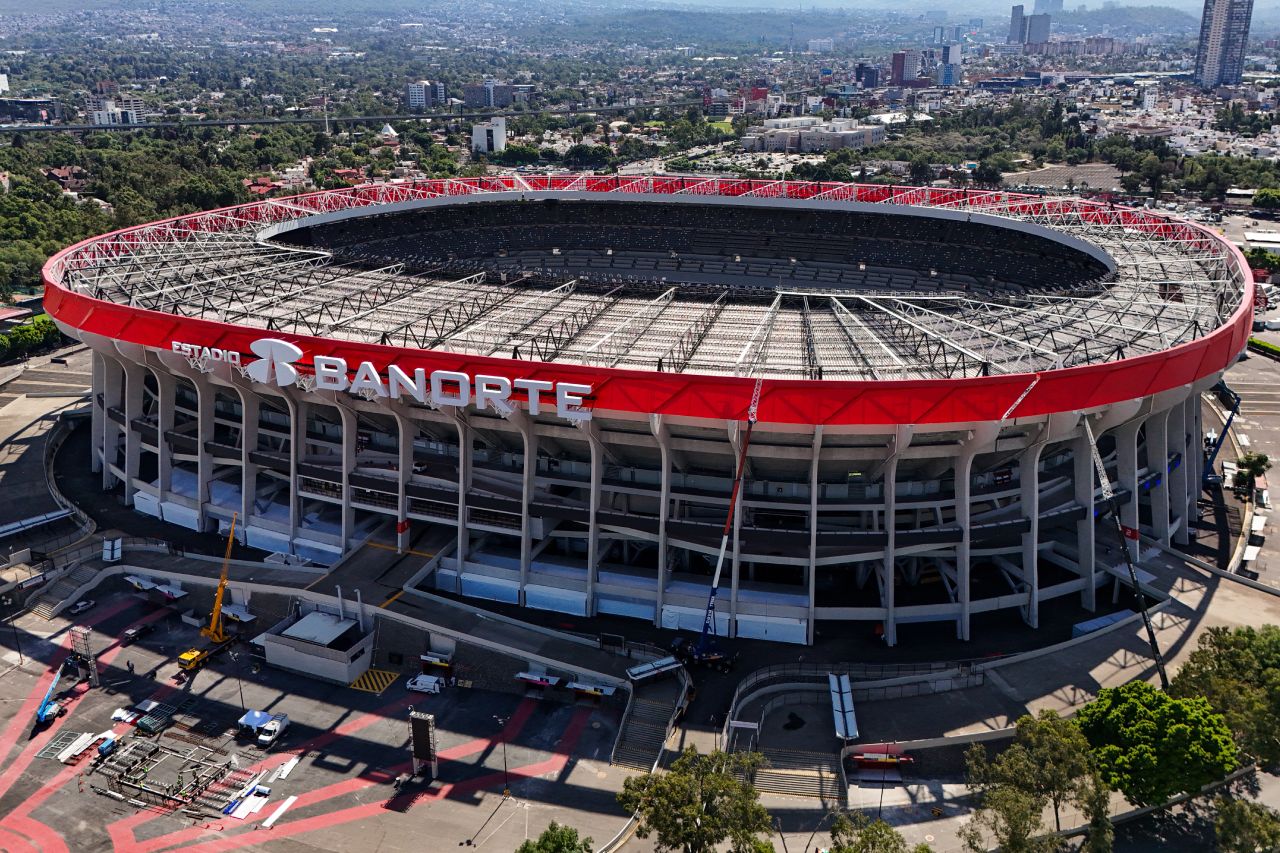
How the Estadio Azteca became the World Cups greatest home
 Fernando Romero NunezJune 9, 20264 Mins read
In the world of football, only a handful of stadiums have reached mythical status. The Maracana, Wembley or La Bombonera are all recognized internationally as hallowed turf for fans. However, none of those come even close to México’s Estadio Azteca when it comes to World Cup history. On June 11, when the ball rolls for the first time in the 2026 FIFA World Cup, it’ll set the record as the only ground to host the tournament’s opening game for a third time: 1970, 1986 and 2026. Having recently celebrated its 60th birthday, let’s take a look at how the Estadio Azteca — literally, Aztec Stadium — came to be, how it got its iconic name and how it’s evolved through the ages. A dream of Mexican football The most famous stadium in all of México is the brainchild of two men, Emilio Azcárraga Milmo and Guillermo Cañedo. Azcárraga, son of Televisa media network founder Emilio Azcárraga Vidaurreta, was a businessman who bought Club América in 1959. The purchase of one of Mexico’s most successful and well-supported teams put him on the path of Cañedo, president of Club Deportivo Zacatepec, the leading Mexican team at the time. Backed by Azcárraga, Cañedo reached the presidency of the Mexican Football Federation (FMF, for its Spanish initials) and started working on the dream of hosting the FIFA World Cup by 1970. A key step in that was the construction of a massive, brand-new stadium that could rival the world’s biggest and most important football grounds. Riding the wave of a flourishing era in the country’s economy known as the “Mexican miracle,” construction on the new stadium began in August 1962. Hard rocks and popular vote The project didn’t start in the best possible way. The site chosen for the new stadium in southern Mexico City was composed of basaltic rock. Some 180,000 tons of rock had to be blasted away to prepare it for the construction, but it wasn’t enough. As a result, the architects Pedro Ramírez Vázquez and Rafael Mijares Alcérreca decided to build up, constructing a platform on which the stadium sits. Hundreds of farming families had to be relocated to construct the building, parking lots and access routes. Originally budgeted at 95 million Mexican pesos (about 1,350 million in current money, or US$78 million), it ended up costing over 200 million (US$160 million), with construction finishing two years late. The stadium was opened in May 1966 Neither Azcárraga nor Cañedo decided the name. The Mexican Postal Service organized a contest, with people sending their choice for the name in letters, and the option with the most votes winning. The first person to submit the winning option would be crowned the winner. A man named Antonio Vázquez Torres got the nod, earning him two guaranteed box tickets for the next 99 years, set to expire in 2065. Three World Cups The Estadio Azteca’s trial of fire undoubtedly came in 1970. It hosted 10 games during that year’s World Cup, including all of Group 1’s clashes, one of the quarterfinals, one of the semifinals, the third-place match, and the final. With 1970 being the first time the World Cup was broadcast in color, the stadium became inseparable from the shine of Pelé’s bright yellow Brazil jersey, as the legend lifted his third and final Jules Rimet Trophy at the Azteca. “The Azteca has something very special,” said Pelé many years later, remembering the win. “You have to be there to feel it and understand it. It’s one of a kind.” One year later, the Azteca hosted another World Cup, one that FIFA fails to recognize. In 1971, the Federation of Independent European Female Football organized a women’s World Cup in Mexico. The tournament featured six national teams from Latin America and Europe, and became a historic precedent for women’s football. Denmark won the title, beating Mexico 3–0 in front of a 110,000 crowd at the Azteca. On October 25, 1982, Colombia officially withdrew from hosting the 1986 FIFA World Cup due to a deep economic and social crisis. Struggling for a host, FIFA offered it to Mexico, which accepted the challenge. It was the first time the Azteca underwent a major refurbishment, with its capacity increased to over 114,000. As it had done with Pelé, the Azteca became the venue for Argentine superstar Diego Maradona’s greatest hour. Argentina’s wins against England in the quarterfinals, Belgium in the semis and West Germany in the final were hosted at the stadium, the first to do it twice. “This stadium is the cathedral of my life in football,” said Maradona in 2000, during a visit to the Azteca with a TV show. “Here I lifted the World Cup, and I scored my best goal, one that many consider the best ever in a World Cup. I’m flooded with feelings.” A renewed giant The refurbishment in 1986 wasn’t the only one the iconic stadium has undergone. In 1999, the visit of Pope John Paul II and selection as a venue for the Confederations Cup prompted a second renovation, during which the capacity was reduced to the original 110,000 seats and two giant screens were installed. The next major refurbishment was completed in 2016. As part of the requirements by United States sports league NFL to host games, a new set of VIP areas, executive suites, and new boxes was built. Additionally, new lighting and press areas were constructed, with the whole works reducing capacity to 83,000. For the 2026 World Cup, the stadium’s owners announced a US$300 renovation. It included reengineering of the players’ areas and the field’s drainage system, new internal walkways and a new hybrid turf. The seating and boxes were renovated, and a full set of hospitality, restaurants and panoramic-view terraces was added. The giant screens were also upgraded to LED 4K, and the stadium was covered with a weather-resistant thermoplastic polymer. Brought to the cutting edge of the 21st century, the Estadio Azteca won’t look like the historic venue it is. Fans could be fooled into forgetting the legends that played on its pitch the day it gained not just the record as the only stadium to feature in three World Cups, but also another game to its tally of 19 World Cup games hosted, the most of any football venue in the world. Cover Photo: Wikimedia Commons


CONMOCIÓN: murió Rosa del Valle Rasgido
 notienredSeptember 13, 20260

Claudio Barrelier reveló por qué mató a Agostina Vega: Obsesión por la
notienredSeptember 13, 20260

Asesinaron a Alfredo Wiebel y se dieron a la fuga
notienredSeptember 13, 20260



Clima en Ciudad de Buenos Aires: sábado 12 de septiembre
Sábado en la Ciudad de Buenos Aires con una temperatura máxima de...
 WindwhistlerSeptember 13, 20260
