
Argentina is safer to lend to. Is it safe enough to invest long-term?
 Adrian GenesirMay 30, 20265 Mins read
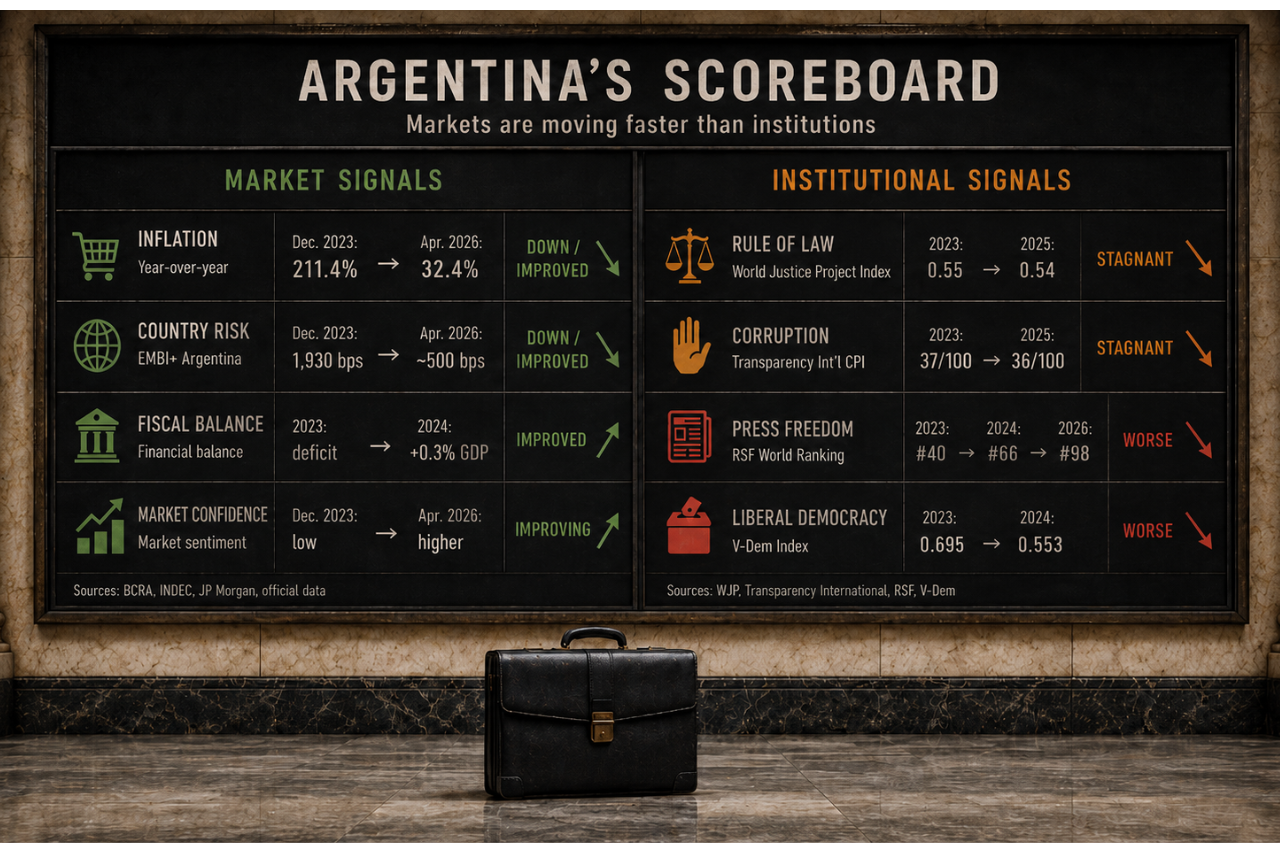
Argentina is becoming more attractive to lend to. That is not the same as becoming more trustworthy to investors. That distinction matters at a moment when Javier Milei’s government has real macroeconomic achievements to show. Country risk hovers around 500 basis points. Inflation, while still high by international standards, is no longer the runaway force it was at the end of 2023, when the libertarian took office. The fiscal balance has moved from chronic deficit to surplus. Markets that spent years treating Argentina as a pariah are, at least for now, less afraid. None of this is cosmetic. Lower country risk can reopen the conversation about capital-market access. Lower inflation makes pricing, contracts, salaries, and investment planning less absurd. Fiscal discipline matters in a country where public accounts have often been treated as someone else’s future problem. A government that reduces inflation, restores fiscal order, and improves financial credibility deserves to claim those achievements. But the prosperity promised by the government is dependent on more than just macroeconomy. Country risk measures something important, but narrow. It tells us how investors price the probability that Argentina will repay its debt. It does not measure whether courts are trusted, whether rules are predictable, whether institutions employ arbitrary power, whether criticism can be made without fear of retribution. It also doesn’t indicate if public data is credible or whether enough people participate in economic life for growth to become politically durable. The importance of strong institutions That second question sits at the center of one of the most influential economic arguments of this generation. In 2024, the Nobel Prize in Economic Sciences went to Daron Acemoglu, Simon Johnson, and James A. Robinson for their research on how institutions shape prosperity. Their work argues that countries become durably rich when they build inclusive institutions: systems that generate trust, enforce rules predictably, constrain arbitrary power, provide credible information, and allow broad participation in economic life. This is not an argument against markets. It is an argument about what markets demand to create the long-term ties that fuel a country’s prosperity. Take corruption. Milei came to power promising to destroy the “caste,” a word that compressed decades of frustration with political privilege, public waste, and a state often experienced as opaque or captured. Yet Transparency International’s Corruption Perceptions Index does not show an institutional cleansing. Argentina scored 37 out of 100 in 2023 and 36 in the 2025 index, measured before the current scandal with Milei’s Chief of Staff Manuel Adorni. That is not a dramatic collapse, but it is also not evidence that anti-caste politics has translated into less corruption. The rule of law picture is similar. In the World Justice Project’s Rule of Law Index, Argentina scored 0.55 in 2023 and 0.54 in 2025, ranking 65th out of 143 countries in the latest edition. Again, this is not a story of institutional free fall. It is a story of stagnation, or even slight regression, where the economic narrative suggests acceleration. Rule of law is the grammar of investment. Press freedom points in a more clearly negative direction. Reporters Without Borders ranked Argentina 40th out of 180 countries in 2023. By 2024, after Milei’s first months in office, Argentina had fallen to 66th. In the 2026 index, it ranked 98th. The closure and later dissolution of state-owned news agency Télam, the president’s repeated public attacks on journalists, and the use of official communication against critics are not side issues. A functioning press is part of a country’s accountability infrastructure. Democracy indicators raise a similar warning. Argentina is not an authoritarian regime, and the point is not to inflate the argument beyond recognition. Elections remain competitive. Congress still matters. Courts still act. Governors, unions, journalists, and civil society continue to push back. But the independent research institute V-Dem’s liberal democracy measure fell from 0.695 in 2023 to 0.553 in 2024, a sharp one-year decline. Whether one agrees with every methodological choice or not, the direction is not what one would expect if macroeconomic stabilization were automatically producing institutional strengthening. What’s working There are, to be fair, indicators and policy choices that may move in the government’s favor. Deregulation, simplification, and the removal of bureaucratic obstacles can improve the business environment. For many companies, dealing with the Argentine state has long meant delay, ambiguity, discretion, and paperwork that served no public purpose. Done well, simplification can be institution-building. But there is a difference between a smaller state and a better state. A bloated, arbitrary state is a problem. A weak, erratic, or personalized state is also a problem. INDEC is another important counterexample. Argentina’s national statistics agency was once a symbol of institutional manipulation. Under this government — whatever disputes exist over interpretation — its core inflation and poverty releases have retained enough credibility to be used by markets, analysts, and international institutions. That matters. A country cannot build trust without public numbers people are willing to believe. Speed versus trust Milei’s sweeping deregulation decree and the government’s broader reliance on emergency-style executive action may be defended as necessary tools to move quickly through a blocked system. But the method still matters. If reform depends too heavily on exceptional authority, personal confrontation, or the constant framing of institutional resistance as sabotage, then the country may be changing policy faster than it is building trust. The failed attempt to appoint Ariel Lijo and Manuel García-Mansilla to the Supreme Court by decree during a congressional recess raised the same question: whether speed was being prioritized over institutional legitimacy. The clearest example may be RIGI, the large-investment incentive regime created under the Ley Bases. As a pro-investment policy, it is easy to understand. Argentina needs capital, infrastructure, energy development, mining, and long-term projects. Investors want tax, customs, foreign exchange, and regulatory guarantees that survive the daily volatility of Argentine politics. A special regime can help unlock projects that would otherwise remain on paper. But RIGI also exposes the deeper point. If Argentina needs an extraordinary regime with long-term guarantees to attract large investments, it is because the ordinary institutional environment is not trusted enough. The special framework is both a solution and a confession. It admits that the general rules are not yet credible, so we will create a protected lane for those willing to come anyway. That may be necessary. It may even be smart. But it is not the same as making the whole country institutionally reliable. Is it enough? In Acemoglu, Johnson, and Robinson’s terms, the question is whether reforms are making institutions more inclusive and broadly predictable or whether they are creating selective islands of certainty for those powerful enough to negotiate protection from Argentina’s ordinary uncertainty. A Milei-sympathetic reader could object that institutional indexes move slowly, that two years is too short a time to measure whether a government has rebuilt a country that inherited inflation, fiscal disorder, regulatory chaos, and a political system skilled at blocking change. That objection has weight. But it cuts both ways. If institutions take time to improve, then macro stabilization cannot be sold as proof that Argentina has already become a trustworthy long-term investment destination. This may help explain why the government can celebrate real macro wins while major foreign investment remains cautious. An analysis by Misión Productiva (Productive Mission) based on figures compiled by the Organization for Economic Co-operation and Development (OECD) showed Argentina finishing near the bottom of Latin America in foreign direct investment performance in 2025 despite improving macroeconomic indicators and falling country risk. It suggests financial markets are regaining confidence faster than long-term investors are. A company building a mine, factory, data center, energy project, or logistics network needs more than improved spreads. It needs to believe that contracts will be honored, courts will be credible, permits will be predictable, social conflict will be manageable, and rules will not depend entirely on the political strength of one president. Argentina may be becoming safer to lend to before it becomes safe enough to build in.



Conectividad regional, auge de escapadas y la pasión por el turismo deportivo del viajero argentino
El pulso del turismo emisivo en la Argentina atraviesa un momento de...
 WindwhistlerOctober 13, 20260

El último tiro cambió todo: pescó un pez elefante y ganó $ 20.000.000
Promediando el cierre de la semana pasada los pronósticos parecían tronchar la...
WindwhistlerOctober 13, 20260

Así rescataron a un cachorrito de lobo marino de un pelo en los médanos de Miramar
Un sorpresivo y emotivo procedimiento de preservación ambiental conmovió por completo a...
WindwhistlerOctober 13, 20260



Proyectan exportaciones récord del agro en 2027, pero advierten que aún faltan dólares para el año electoral
A un año de las elecciones presidenciales, la pregunta sobre si estarán...
WindwhistlerOctober 13, 20260
